Showing posts with label tyndale. Show all posts

Saturday, 19 June 2010

The End is Nigh....


Time flies, and one month has quickly gone by and my time at Tyndale House in Cambridge is about to come to an end soon. Work has been progressing well, and I must say I am rather pleased with the progress thus far. I managed to tidied up the Introductory chapter of the book I am working on, and made significant revision on 3 other chapters. What's left for me is to tidy up the manuscript and then perhaps look for a publisher to publish my work.

This visit to Cambridge is also a very memorable one, and I will blog in the next post why this is so. Friends who have been following me on my Facebook would probably able to guess the reason for this.

This is my final weekend here - and I am going to chill out and have a little break before heading home.

Sunday, 30 May 2010

Work Begins....


I arrived Tyndale House on Tuesday late morning after a long flight from Kuala Lumpur via Singapore. Strangely, for this trip, I find it rather difficult to get things moving for the past week. I guess this is partly due to the reason that I had been very exhausted at the end of the semester. It was also towards the end of the semester that I was given the added responsibility of faculty in charge of the library. Much time was taken up to look into various issues related to the library and to consider how to make the library a more conducive place for all to work, study, research, and perhaps,to play! (yes, one can still have fun in the library!). So it was no wonder that I spent the last couple of days in Cambridge recuperating.

Since my last trip to Tyndale end of last year, nothing much has been done to my research. So for the last few days, I was ploughing through my notes, trying to figure out where I left off the last time I touched on my book project. It was not until yesterday that I think I finally gained my footing. So I am hoping that for the weeks to come, it would be another fruitful time for me at Tyndale! In the meantime, I have the books sitting on my the shelve above my desk that I need to browse through!

Monday, 24 May 2010

Upcoming Visit to Tyndale House


The last few weeks have been very hectic for me - additional administrative duties have been loaded onto my lap, and much time has been taken up to look into these new responsibilities. And much time has been diverted from my research and writing project.

But having said that, I am now looking forward to a month's concentrated research and writing period at Tyndale House, Cambridge. I will be hiding in Tyndale's excellent library, working on my manuscript. So I will be eating, working, and sleeping in the library, almost literally - after all, my accommodation is just directly above the library!

So bon voyage to myself!

Wednesday, 9 December 2009

5 Weeks: What Have I Achieved at Tyndale House?

My time at Tyndale House, Cambridge, has almost come to an end. I will be flying home tomorrow night. Time flies, and 5 weeks just seem like a few days for me. I have been clocking in almost 10-12 hours of work in the library daily from Mondays to Saturdays, not to mention that I continue to work most of the evenings when I got home [I hope this can assure my colleague that my trip to Cambridge is really work. He keeps on teasing me and insisting that I am having a nice vacation in Cambridge with plenty of 'kiau kah' (literally means 'shaking legs' or 'crossing legs') sessions. Well, to be honest, I don't even have time to 'kiau kah' although I truly wish I could!]

So what have I achieved in these 5 weeks?

First, I have completed a draft of a 8000-word essay that will be published in a compendium of essays on Paul and Identity Formation to be published by T&T Clark next year.

Secondly, I have also made some progress in my writing for my book on Paul's Use of Images in the Corinthian Correspondence. I've made some changes to the introductory chapter and further clarified the methodology. I also did some additional writing on some of the chapters, tidied up some of the arguments, and also updated my reading on issues related to these chapters.


Although my progress falls short of my initial target, I must say I am still pleased with the achievements thus far. It would have been nice if I have a 4-5-month sabbatical soon, then I would be able to complete the first draft of the book. But I have to accept the reality of teaching in Malaysia that sabbatical is a privilege and not a right, so I am not sure where such privilege will be accorded. Nevertheless, I am thankful I have the 5-week period to work on the book - that itself I am grateful.

I will miss Tyndale House and its excellent resources.

Friday, 4 December 2009

1 More Week to Go

I have not been too active in the blogsphere lately. It's not that I do not have anything to blog. My time has been largely consumed in trying to get as much work done as possible before the end of my stay at Tyndale House.

Time flies - and by next week this time, I will be at Heathrow airport waiting for my flight home. I look forward to being home, but at the same time, I will miss all the resouces here at Tyndale. It's kind of a paradox.

It's back to work for now.

Friday, 27 November 2009

It's Been A Sunny Week


I must say that I am pleasantly surprised by the British weather this week. Although it is slightly colder than last week, it has been sunny for most of the days! This is a rarity for the British weather! So for the sunny weather, I am very grateful and thankful. It just cheers up the week and gives the needed boost to continue my work that has been slightly behind schedule!


PS - Hope the Reb has equally nice weather in Oxford.


Thursday, 26 November 2009

Work Progresses at Tyndale


Time flies - it has been more than 2 weeks since I arrived at Cambridge. Work on my book has been progressing rather well - but at a rather slow pace - this is partly due to the fact that there is quite a fair bit of catching up for me to do in my reading. There has been a large number of significant monographs being published in Pauline studies in the last year or so. Scholarship is progressing at a rather fast pace, and this can be seen in the high number of PhD theses that are being published by major academic publishers. From the photo above, these are shelves containing books on the Corinthian correspondence - how can one finish reading these in 5 weeks?

I have 2 more weeks to go before heading for home - and I wish time could slow down a bit for me.

Tuesday, 17 November 2009

The Old and the New in England!

My colleague, the Rabbi, has safely arrived Oxford. He will be here for his pre-viva at the Oxford Centre for Mission Studies and also to get his thesis ready for submission. So both the Old (ie OT lecturer) and the New (ie NT lecturer) from the seminary are now both in England - and ironically, the former is in Oxford and the latter is in Cambridge. Hence, one of our students, SP, commented that the rivalry just does not stop in Malaysia!

All the best to the Rabbi. Hope you have a fruitful time in Oxford. Do drop by Cambridge for a visit. Tyndale House beckons you!

Saturday, 14 November 2009

First Week at Tyndale

It's coming to the end of the week, and I am taking a moment to pause and reflect on my work throughout the first week of my time at Tyndale House, Cambridge. After having put in more than 10 hours daily (working from 9am till 9pm daily!), I must say it has been rather mixed.

Early on this week, I made some really good progress in terms of my reading. However, in the mid week, things seemed to hit a snag as I was not able to put my finger on the stuff I was looking for. Perhaps I had been asking the wrong question. It was not until this morning that I finally see the light when I decided to make a slight change on the thrust of my argument in the chapter that I am currently working on for my book, Paul's Use of Images in the Corinthian Correspondence.

I hope to be able to complete the first draft of my chapter by the end of next week. It's an ambitious aim. But considering the fact that I do not have the luxury of time, I have to make the best out of everything.


But it's not all hard work and no play. This weekend, I am heading to London to meet up with my relatives for a dim tum lunch at Chinatown and to drop by the British Library where I will be visiting the Sir John Ritblat Gallery to have a peek at the Codex Sinaiticus once again. Looking at the real thing is surely better than having to look at the online version!

Tuesday, 10 November 2009

Work Progresses at Tyndale

I was hoping to go full swing yesterday, but I guess the engine needed some time to warm up (especially in the unusually cold November in England!). So I did not manage to get much work done yesterday. But nonetheless, this morning has been rather productive - been reading a number of books on the temple imagery in both the OT and NT. So, this is how my desk currently looks like in Tyndale House.


I am a bit more persuaded that Paul's use of the temple imagery in the Corinthian correspondence is not simply sporadic, but constitutes a deliberate attempt in creating Christian identity in Corinth. I will blog more about this when my mind is clearer on this subject matter.

I've just managed to locate an online 2008 PhD thesis done by Timothy Wardle at Duke University on "Continuity and Discontinuity: The Temple and Early Christian Identity". It would be good to interact with Wardle and see how he argues for the use of the temple imagery in the creation of Christian identity.

So it's back to work now!

Saturday, 7 November 2009

All Set to start Work at Tyndale House

Bright and sunny morning - the library of Tyndale House

I was greeted with a very bright and sunny morning, a very rare sight in chilly November in Britain! With the jet leg behind me, and after having settled in at my accommodation, I came into Tyndale House this morning to continue locating the books that I might need for my research.

By now, I've got most of the books in place, and this means that I am all set to begin work by next week Monday!


Some of the books needed are now on my desk. How do I devour all of them in 5 weeks, not to mention there will be more to come along the way?

The rest of the quiet Saturday will be spent in trying to catch up with where I left off last year while doing my research at Trinity theological College, Singapore. So it's back to work now!

Friday, 6 November 2009

Arrived Tyndale House, Cambridge

After a long 13-hour overnight flight, I finally touched down at London Heathrow, and made my way to Cambridge. I arrived Cambridge much earlier than expected. After a quick hot shower at the place I would be staying for the next 5 weeks, I headed straight to Tyndale House, hoping to locate my desk and some of the books I need so that I could begin work next week.

My working space for the next 5 weeks

Coming back to Tyndale House has been a real blessing. It also brings back many happy memory of the many months I spent here working on my doctoral thesis.


I look forward to my 5-week stay here.


Oh yes, a small little surprise greeted me when I walked into the library as I browsed through the new arrivals section in the library.

Thursday, 5 November 2009

Off to Tyndale House, Cambridge


In a matter of few hours, I will be flying off to London and thereafter making my way to Tyndale House, Cambridge for a 5-week research and writing on my second book on Paul's Use of Images in the Corinthian Correspondence.

This project has been brewing for a couple of years already. Since I am the most junior faculty member, the dream of having a sabbatical is non-existence for me, at least for many more years to come. As such, I can only squeeze in a period of 5 weeks during the end of the academic year and hope to spend some productive time at Tyndale House, so that I could get as much work done as possible. Like last year, I spent a month at Trinity Theological College working on the framework of the book, and this time, I hope to get some solid background materials done.

I will be blogging from Tyndale House next week and I will be sharing more on my book project.


Wednesday, 30 September 2009

Tyndale Tech: Logos and Libronix


Many of my students have asked me about the differences of Logos, Bibleworks and Accordance. I find myself repeating all the time explaining the differences of these software, their uniqueness and their strengths/weaknesses. I had thought of writing a post on this, but I am glad I don't have to do it now!

David Instone-Brewer of Tyndale House has done us a great favour by giving a very detailed and interesting review on Logos Libronix. If you are still unsure about Logos Libronix, please click here to read Instone-Brewer's extensive review.

Saturday, 13 June 2009

Getting the Best out of BibleWorks 8


Dr David Instone-Brewer of Tyndale House has written an extensive review and offered some excellent tips for using BibleWorks 8 in the lastest issue of Tyndale Tech.

Please click here for David's post.

Sunday, 22 March 2009

Bart Ehrman Debates with Pete Williams


NT scholar Bart Ehrman was in the UK over Christmas 2008 to visit family and promote his book "Whose word is it?", the UK edition of "Misquoting Jesus". In it he calls into question the authority of the New Testament, claiming that scribes have deliberately changed the documents over time.

Premier Christian Radio interviewed him on January 3, 2009 on its programme, 'Unbelievable', and invited Peter Williams, Warden of Tyndale House, Cambridge, to an hour-long debate with him.

The debate focused on the question ‘Do we have the original writings of the New Testament?’ Peter Williams argued that Bart's prognosis about the reliability of the New Testament is far too pessimistic. He agreed that scribal errors have occurred, but they are accidental changes and the original reading is almost always obvious and confirmed by large numbers of manuscripts.

The debate can be heard online by clicking here.

It is also worthwhile to check out Sze Zeng's blog where he highlighted the debate between Bart Ehrman and Dan Wallace.

Saturday, 21 March 2009

Tyndale House Spring 09 Newsletter


Tyndale House has published its Spring 09 Newsletter. Click here to read the latest happenings in Tyndale House.

Thursday, 5 February 2009

Kirby Liang Institute for Christian Ethics Newsletter and Conferences

The Kirby Liang Institute for Christian Ethics at Tyndale House, Cambridge has just released its latest newsletter. Click here for the Winter 2009 issue of the newsletter.

KLICE also announces 2 conferences, details are as follow:

“Responding to Secularism: Christian Witness in a Dogmatic Public Culture”
24 April 2009, Tyndale House, Cambridge
10.00am - 5.00pm

- a day conference on mission and contemporary culture co-sponsored with the Gospel and Our Culture Network (www.gospel-culture.org.uk)

Programme:

Dr Dominic Erdozain (King’s College, London) on the growth of secularity in modern British culture

Prof John Stackhouse (Regent College, Vancouver) on public engagement in a secularised culture

Rev Dr Andrew Kirk (formerly University of Birmingham) on Charles Taylor’s A Secular Age

Dr Elaine Storkey (TEAR Fund) on responding to the secularist worldview

For further details and booking form click here or contact Tania Raiola on administrator@tyndale.cam.ac.uk or 01223 566606.

------------------------------------------------

Justice: Rights and Wrongs. A Colloquium”
with Prof Nicholas Wolterstorff (Emeritus, Yale University)

May 21-22 2009 Christ Church, Oxford

Sponsored by the McDonald Centre for Theology, Ethics and Public Life
(Oxford) and the Kirby Laing Institute for Christian Ethics

Speakers:
Prof Onora O’Neill (British Academy; Philosophy)
Prof Roger Crisp (Oxford; Philosophy)
Prof Timothy Endicott (Oxford; Law)
Prof Julian Rivers (Bristol, Law) (former KLICE Advisory Council Chair)
Dr Bernd Wannenwetsch (McDonald Centre; Theology)
Dr John Perry (McDonald Centre; Theology)

Co-chairs:
Prof Nigel Biggar (McDonald Centre)
Dr Jonathan Chaplin (KLICE)

KLICE doctoral grantee Joshua Hordern (Edinburgh) will prepare a
precis of the book for conference registrants.

Prof Wolterstorff’s book,
Justice: Rights and Wrongs (Princeton University Press, 2008) presents a distinctively Christian theory of justice and rights and has been hailed by Richard Bernstein (New School for Social Research) as "the most impressive book on justice since Rawls's A Theory of Justice".

This event is the 2009 KLICE Annual Book Colloquium.

McDonald Centre website: http://users.ox.ac.uk/~mcdonald/

Further details will appear on the McDonald Centre website and the KLICE website soon. For a registration form contact Jonathan Chaplin on 01223 566625 or klice@tyndale.cam.ac.uk.

Wednesday, 15 October 2008

Tyndale House Newsletter Autumn 2008 is Out


The latest Tyndale House newsletter, Autumn 2008 issue, is now published. Click here to download a pdf copy.

Monday, 11 August 2008

Tyndale Tech: Searching Ancient Greek Literature

Dr David Instone-Brewer of Tyndale House, Cambridge, has just released another issue of Tyndale Tech. This time, he provides excellent tips to help us search for ancient Greek literature. I take the liberty to reproduce the latest Tyndale Tech below:
---------------------------------------------------------------
Searching Ancient Greek Literature

The bread and butter of New Testament studies is finding out how a word is used elsewhere. Usually this means looking it up in a good lexicon, but a real scholar does a word search. This has recently got a whole lot easier. TLG and Perseus are still the best sources, but now there are new ways to use them, including instant lexical help which isn't restricted to the speed of the web. Whether you want to do word searches throughout all Greek literature, or you just want to quickly look up a Greek word now and then, read on.

I also want your help adding to the ultimate list of 5000 early Greek texts and translations.
1) TLG - 'All' of Greek literature, in Greek
2) Perseus - the earliest Greek literature, with English
3) Electronic lexicons for Greek - quicker and better than paper
4) Diogenese - the key to reading untranslated Greek
5) Fonts - the easiest Unicode for Mac & PC
6) Finding translations on the web

1) TLG - 'All' of Greek literature. In Greek.
TLG - ie Thesaurus Linguae Graecae contains 'all' of Greek literature by thousands of authors, including 122 from the 1st C AD and 167 from the 2nd C AD. It contains all Greek literature from earliest times till AD 600, and most literature up to 1450. It is still growing, though I fear it will never catch up with itself. As far as Biblical Studies and early church history is concerned, it is complete.

Tyndale House used one of the original Ibycus computers built especially for TLG, with right-to-left Hebrew on the screen together with Greek and English. It was purpose-built and extremely fast, even by today's standards.
Then it was converted to CDs for other computers, with a variety of software, before it moved to the web where it has its own fairly good & fast search engine. But now things are getting faster again, in some ways, thanks to Diogenes (see below). See more history.
TLG is not free, but most institutions with Classics or Bible departments subscribe online. If you aren't near one, an individual licence is about $100 pa.

Hints for using the
online TLG:
  • At the opening screen, start by clicking on "Institution " or "Individual " (middle left)
  • Use the Unicode fonts. These work without installing and copy & paste into your documents.
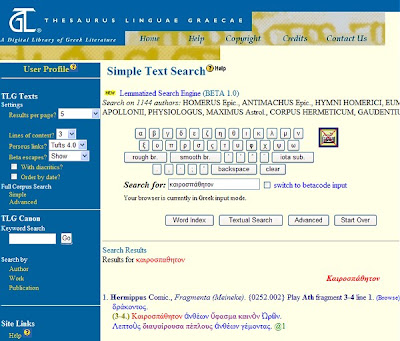
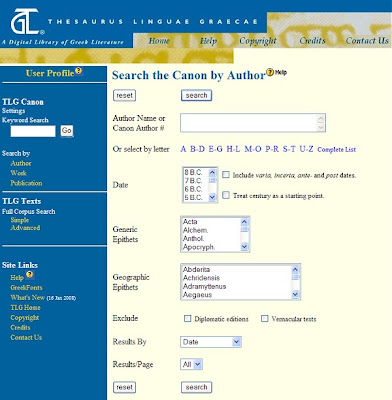
  • To search for a word: Click on "Full Corpus.. Advanced"
  • Before you search, highlight the centuries you want (click on the first, hold Shift, and click on the last), and tick "varia" because this includes the Septuagint, then click on "Search", then "Search All".
  • lick on the typewriter symbol to type Greek letters. Type the word and click on "Word Index".
  • Tick the verbal forms you want and click on "Selected Words".
  • Select "Tufts" in "Perseus links" (top left) to get morphology and lexicons (this is now much faster)
  • If the lexicon lookup isn't fast enough, use Diogenes instead (see below)


2) Perseus - the earliest Greek literature, with English.

Perseus specialises in ancient Greek sources and is not as complete as TLG, but it covers all the main texts, and most of them have English translations available. It also includes papyri, which are NOT covered by TLG (but searching is broken at present). It is hosted at various sites, the best of which is Tufts who now have a new version 4. If you want to host your own, you can download the texts and programs, but you'll need a good Java programmer to install them, and a fast server to host them.

The Perseus Site has many hard-to-find treasures - - use the Tyndale map

Hints for using online Perseus

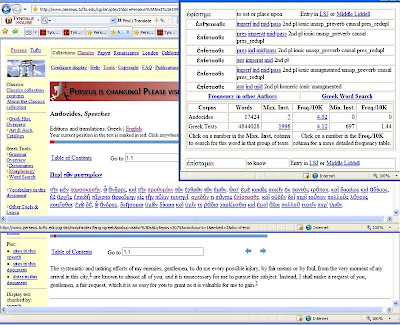
  • Find your text in the list, open it, then hold Shift and click on "English", then resize the windows so you have the Greek and English both visible (see below)
  • Click on a Greek word for morphology & lexicon, and put that window to the side.
  • Click "Configure display" (at top) and select "Unicode with pre-combined accents"
3) Electronic lexicons for Greek - quicker and better than paper

Electronic lexicons are now MUCH faster than English ones, both for looking up and searching. For Greek literature, the best lexicon is Liddell, Scott and Jones, 9th ed, which you can search at:
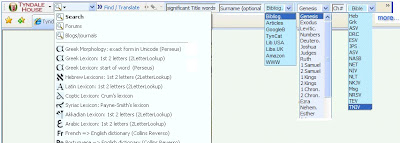
  • - 2LetterLookup. com
  • - click on 2 Greek letters then pick your word. Uses ZHubert & Perseus- Perseus - type in the start of the word without accents and "h" for harsh breathing, eg "huos"
  • - Diogenes (see below) which installs the whole lexicon onto your hard drive for instant access
  • - the Tyndale Toolbar which gives instant access to these and many other lexicons on PC & Macs


4) Diogenes - the key to reading untranslated Greek

Diogenes is a free program for PC & Macs which reads TLG and other texts in Beta code

This will also read the PHI7 CD containing the Duke Databank of Papyri and Greek inscriptions
There have been and are many other programs which do this but Diogenes has one great advantage
- it now includes the full LSJ Greek lexicon as part of the installation, for instant lookups, plus Perseus' Greek morphology (and Latin facilities for the PHI5 CD of Latin inscriptions)
You can use the Lexicon and morphology facilities without the data CDs.

The big problem is how to get hold of the TLG and PHI7 CDs. TLG themselves used to supply them, and they might still do so, but most subscriptions are now online.There are now extra texts available online, but they are later and of little interest to Biblical scholars. So far as I know, you can legally continue to use the old CDs so long as you have an online subscription.

If you have access to the CDs, AND you have an online subscription to TLG, do the following:
  • - copy the CDs into folders on your network, making them read--only and prevent copying
  • - tell users to click on 'Settings' in Diogenes and paste in the network addresses for the 3 CDs (see the instructions for the electronic facilities available at Tyndale House, under "TLG")
Of course, you could just come to Tyndale House and use the facilities here!

Hints for using Diogenes
Download Diogenes for Mac ( instructions) or for PC ( instructions).
Click on "Edit: Preferences" - set "How to present Perseus data" to "Pop up"
Set "Greek Input" to Unicode (see Fonts below) or BETA transliteration
Change to Unicode when typing a Greek word, otherwise it will look up Latin words.
You don't need the CDs to use the Lexicon or morphology parsing.
If you have the CDs, searching for a word is slower than online, but reading is faster, because the words are linked to instant parsing and full lexicon help, and any reference you click on in the lexicon takes you to the full text of that example.


5) Fonts - the easiest Unicode for Mac & PC

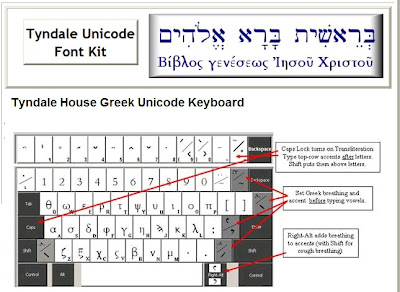
All of the above work best with Unicode fonts. Your computer already has rudimentary Unicode Greek but lacks accents and breathing. Install the Tyndale Unicode Kit - free, easy, fully configurable, and now with added help.
This gives you the wonderful Cardo font, with academic Greek, Hebrew and Transliteration.

For the best web experience, set your browser to Cardo.

  • eg for IE7: Press Alt; Tools; Options; Fonts; Latin based = Cardoor
  • for Firefox: Tools; Options; Content; Default font = Cardo
6) Finding translations on the web

Even when Diogenes gives you instant morphology and lexical help, an unknown Greek text is difficult to read. The key to faster working is to find a good translation to guide you. The following are good lists of online translations:

  • Perseus - a wide variety of translated texts, with Greek originals too
  • Greek Authors on the Web - collects links from all over. Some are dead.
  • Internet Classics Archive - a well-organised collection.
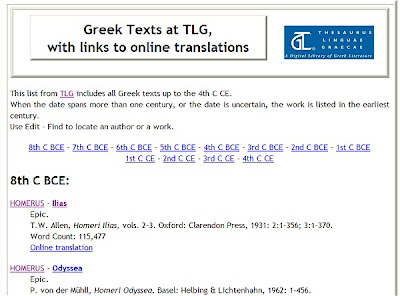
  • TLG - I've created a list from TLG of all 5079 Greek texts up to 4th C CE, with links to 451 online translations (incl. 16% of all texts before 2nd C CE)
Please help to grow this list!

There are lots more texts 'out there' which aren't listed, and Google is the best help for finding them.

Hint: Search for proper names which occur in the text, or rare words.
If you find that a link to a translation no longer goes anywhere, don't panic.
Paste the link into the WayBackMachine at Archive.org and it is often there. When you find one please tell me which text it is on the list, and I'll add it.